 English
GET International
Guild of Educators in TESOL International Institute
Your Gateway to Countless Opportunities
Our Courses
Certificates and diplomas for teachers and professionals, studied online at your own pace.
English
 Research
 Humanities and Social Sciences
Featured Videos
Distinguished Teachers' Training Institute Award
1st Batch - Diploma in Research Writing and Publication
What's New
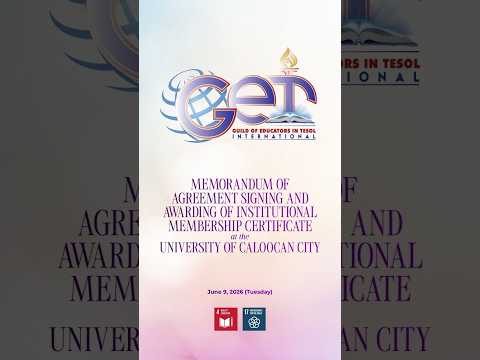
OUR NEWEST MEMBER, UNIVERSITY OF CALOOCAN CITY!
The Guild of Educators for TESOL International Institute (GET International) officially welcomes the University of Caloocan City (UCC) as its newest institutional member during the Signing of Memorandum of Agreement and Awarding Ceremony held last June 9, 2026 at the UCC Conference Room.

PURIHIN NATIN NANG BUONG PAG-IBIG, ANG METRO MANILA COLLEGE!
The Guild of Educators for TESOL International Institute (GET International) officially welcomes Metro Manila College (MMC) as its newest institutional member during the Signing of the Memorandum of Agreement and Awarding Ceremony held last June 23, 2026, at the MMC Meeting Room.
Is TESOL Program for You?
The TESOL (Teaching English to Speakers of Other Languages) program is an interdisciplinary field that draws from various academic disciplines. Here are some of the disciplines that are closely related to and often contribute to a TESOL program:
Linguistics
Linguistics is at the core of TESOL. Understanding the structure, sounds, and grammar of languages is fundamental for teaching English effectively. Subfields like phonetics, phonology, morphology, syntax, and semantics are essential.
Second Language Acquisition (SLA)
SLA is a field of study that explores how people learn a second language. TESOL programs often incorporate SLA theories and research to inform teaching methods and curriculum development.
Pedagogy
Pedagogy refers to the science and art of teaching. TESOL programs cover various teaching methodologies, classroom management techniques, and assessment strategies tailored to language instruction.
Cultural Studies
Understanding cultural differences and their impact on language learning is crucial in TESOL. Cultural studies provide insights into the social and cultural contexts in which language is used.
Technology in Education
The integration of technology in language teaching is becoming increasingly important. TESOL programs often include coursework on educational technology, computer-assisted language learning (CALL), and online teaching.
Sociolinguistics
Sociolinguistics examines the relationship between language and society. It helps TESOL professionals understand how social factors, such as identity, power, and language variation, influence language learning and use.
Psychology & Applied Linguistics
Understanding cognitive processes related to language learning and teaching is essential. Educational psychology and psycholinguistics contribute to effective language instruction.
Anthropology
Anthropological perspectives on language and culture provide insights into how language is intertwined with human societies and can enhance cross-cultural understanding in TESOL.
Education
TESOL is a subset of the broader field of education. Courses in curriculum design, educational research, and assessment are relevant to TESOL professionals.
Psychology
Understanding the psychological factors that affect language learning, such as motivation, anxiety, and learning styles, is important for TESOL practitioners.
Technology
As the world becomes more digital, TESOL professionals need to be proficient in using technology for teaching and learning, including online platforms, multimedia, and language learning apps.
Social Sciences
Various social science disciplines, including sociology and political science, can provide valuable perspectives on the role of language in society and the politics of language education.
Criminology
While not traditionally linked to TESOL, criminology professionals can benefit from TESOL training, especially in multilingual law enforcement settings and correctional education programs.
Tourism Management
Tourism professionals frequently interact with international clients. TESOL training enhances communication skills, cross-cultural competence, and the ability to deliver hospitality services in English-speaking contexts.
Hotel Management
Hotel management professionals benefit from TESOL certification as effective English communication is essential for guest relations, staff training, and international hospitality standards.
Security Management
Security professionals working in international or multilingual environments can leverage TESOL training to improve communication protocols, incident reporting in English, and cross-cultural coordination.
TESOL is a multidisciplinary field that benefits from contributions from these and other disciplines. Professionals in TESOL often draw on knowledge from multiple areas to create effective and culturally sensitive language teaching practices.
TESOL Certified Professionals
The Outstanding Graduates of the Diploma in TESOL Program
Shared with each graduate's permission. These are individual experiences — results vary, and completing a course is not a guarantee of employment or placement.
TESOL CERTIFIED